University of Richmond Athletics
11/19/2026 | Football
From earning a scholarship to overcoming a devastating leg injury, Richmond's Sean Clarke has built a career defined by perseverance, growth and leadership. As his final game approaches, the graduate tight end has become an example of what it means to never give up.
IT HAD ALREADY BEEN AN UNUSUAL NIGHT IN SPARTANBURG, S.C.
A 90-minute weather delay had pushed back kickoff of Richmond's SepT., 6 2025 matchup at Wofford. By the time the Spiders finally took the field for what was originally scheduled for a 6:00 start, they were in for a long night that would eventually end with a hard-fought 14-10 victory.
But for one Spider, the night would be remembered for something entirely different.
3:57 FIRST QUARTER; 3RD AND 9 FROM THE RICHMOND 11
Quarterback Kyle Wickersham took the snap in the shotgun, looked downfield and found tight end Sean Clarke on a crossing route over the middle.
Clarke made the catch for a 20-yard gain and a Richmond first down.
End of play.
On the stat sheet, it was an ordinary completion during Richmond's second game of the 2025 season. For Clarke, it was the beginning of the most difficult year of his football career.
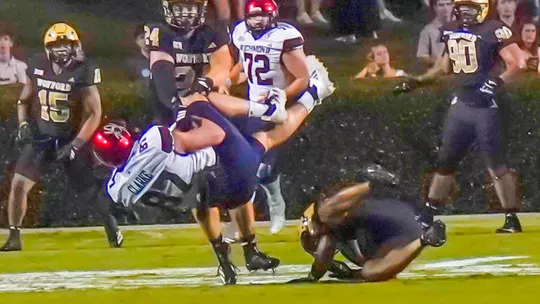
As Clarke came down with the catch, a defender struck him directly in the thigh, sending him somersaulting through the air. He initially thought he had absorbed a particularly painful hit. When he tried to get up, he couldn't.
"I thought it was the worst bone bruise I ever got in my life," Clarke said.
It wasn't a bruise.
Clarke had suffered a displaced fracture of his femur, the longest and strongest bones in the human body. The impact had broken his thighbone into two separate pieces.
There was a time when Clarke wasn't sure when he would walk normally again, let alone run routes, make catches and contribute on a football field.
Today, as the Richmond graduate tight end prepares for the final game of his college career, he has done far more than simply return to football.
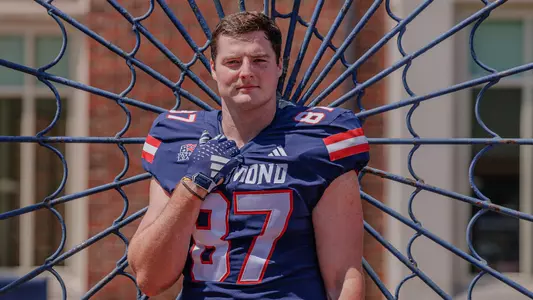
He's become a team captain, one of the Spiders' leading receivers and a respected voice inside the program. His journey from preferred walk-on to scholarship player, starter and leader has been marked by steady growth, determination and a willingness to keep working through circumstances that might have caused others to give up.
The injury at Wofford was the greatest test of those qualities. But the foundation for his comeback had been established years earlier.
EARNING HIS PALCE
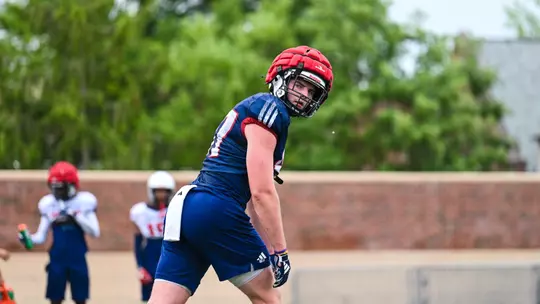
Clarke arrived at Richmond from Connecticut without a scholarship or any guarantee of what his college football career might become.
A high school wide receiver at Staples and later Suffield Academy, he had attended a Richmond summer camp and earned an opportunity to join the Spiders as a preferred walk-on.
He would have to earn everything that followed.
Clarke began the process of transforming himself from a receiver into a college tight end, adding weight, building strength and learning the responsibilities of a new position. Progress came gradually, through practices, weight-room sessions and the daily work that rarely makes headlines.
Kyle Edwards, Richmond's tight ends coach, remembers noticing Clarke during his first practice with the Spiders as a new member of the coaching staff three years ago.
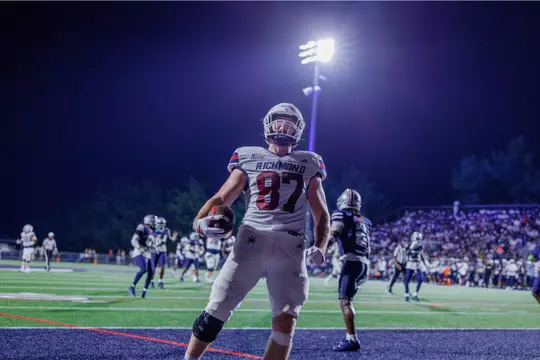
The player wearing No. 87 caught his attention with his ability to catch, block and run. When Edwards learned Clarke was initially a walk-on, he was surprised.
Clarke's development eventually earned him a scholarship during the spring of his sophomore year, a milestone that validated the work he had invested in the program.
He continued to grow into a more complete tight end and worked his way into Richmond's offense.
By the time the Spiders traveled to Wofford in September 2025, Clarke had developed into a player the coaching staff could trust.
Then, in an instant, his progress came to a halt.
STARTING OVER
For Richmond's athletic training staff, the severity of Clarke's injury was apparent almost immediately.
Joe Olivadoti, Richmond's head football athletic trainer, noticed that Clarke's thigh appeared visibly angled, a sign that something far more serious than an ordinary football injury had occurred.
Olivadoti had never encountered a displaced femur fracture during his time at Richmond. It was the kind of injury more commonly associated with car accidents or military settings than a college football game.
The medical staff had to hold Clarke's leg in traction to maintain its length. When the femur breaks, the powerful muscles surrounding it begin to contract and shorten the thigh.
Clarke was transported to a nearby hospital in Spartanburg, where he underwent surgery the following morning.
Doctors inserted a titanium rod through the center of his femur, securing the broken bone with screws near his hip and knee.
He remained hospitalized for several days before his parents drove him back to Richmond.
For a player who had spent years building himself into a college tight end, the injury meant starting over in ways he could never have imagined.
At first, the goal wasn't returning to football.
It was walking.
The initial stages of rehabilitation involved crutches and gradually rebuilding his ability to move normally. Even after he regained enough strength to walk, his body had developed habits that needed correcting.
His muscle memory had changed. He was walking with a limp, and his gait was uneven.
Relearning those movements became a major part of the process.
The physical challenges extended into the weight room. Clarke had worked for years to build the strength necessary to play tight end. Now, much of that progress had disappeared.
He remembered beginning his return to squatting at just 135 pounds.
"One day you can run fast and lift, squat a whole bunch of weight, and the next day you can't at all," Clarke said.
The experience forced him to find a different kind of strength.
Progress that had once been measured in catches, blocks and pounds lifted was now measured in steps, range of motion and small improvements that often took weeks to achieve.
Patience became essential.
So did the willingness to keep showing up.
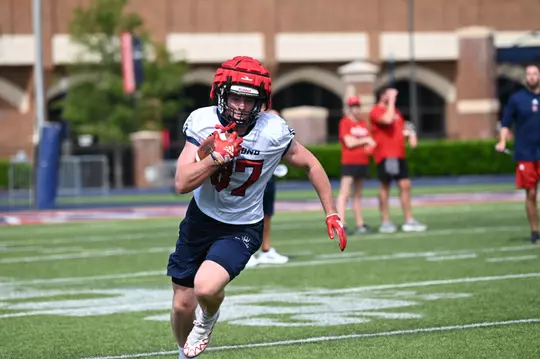
LEADING WITHOUT PLAYING
One of the most difficult parts of Clarke's recovery was watching his teammates practice and compete while he remained on the sideline.
He wanted to contribute. He knew the offense, understood his responsibilities and believed he could help the Spiders.
But physically, there was little he could do.
"Not being able to be out there when you know you could help the team. It's just a crappy feeling," Clarke said.
Rather than distance himself from the program, Clarke found other ways to contribute.
He remained involved with the tight ends, helped younger players learn the playbook and continued attending practices and team activities.
Edwards remembers seeing Clarke for the first time after surgery.
A few days after the injury, Clarke had returned to the Richmond facility. He was still in considerable pain, wearing clothes his mother had purchased during the unexpected hospital stay in South Carolina.
Edwards made him a promise.
"You're gonna come back stronger than ever from this," he told Clarke. "I promise you that."
Over the following months, Clarke worked with Olivadoti and the Richmond training staff to rebuild his strength and mobility.
During spring practices, he initially stood beside Edwards, helping shag footballs because he wasn't yet able to move around freely.
Eventually, the small breakthroughs began.
One day, with a few extra minutes before practice, Clarke jogged onto the field and caught a pass over his shoulder.
Edwards noticed.
In the weeks that followed, Clarke gradually participated in more throwing and catching drills, looking increasingly like the player he had been before the injury.
But he still wasn't ready to return to full football activities.
Clarke believed there were times when he might have been capable of playing, but he understood the importance of allowing his femur to heal completely.
While his physical recovery continued, something else was happening within the program.
His teammates voted him a captain.
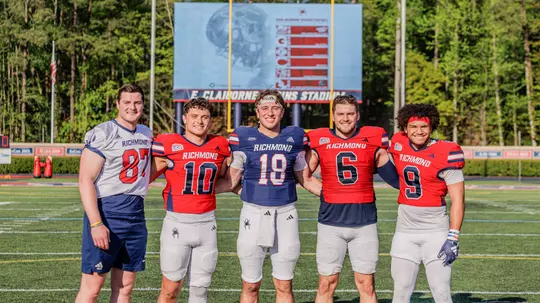
It was a remarkable show of confidence in a player who had missed nearly an entire season and had been unable to participate fully in spring practices.
For Clarke, the recognition meant more because of everything he had been through.
"It showed they respected me," Clarke said. "A lot of the guys had it for me, which I appreciate."
The honor reinforced something Clarke had learned during his recovery: Leadership isn't necessarily about making the biggest play or being the loudest voice in the room.
Sometimes, it's about being present, setting an example and doing the right things when nobody is watching.
He couldn't always lead his teammates onto the field. But he could show them what commitment looked like away from it.
A SEASON WORTH THE WAIT
By the time Richmond opened training camp in 2026, Clarke had made remarkable progress.
The player who had struggled to walk without a limp was running routes, making catches and moving with a confidence that would have seemed unimaginable during the earliest stages of his rehabilitation.
Edwards said that watching Clarke on film, it would have been difficult to tell he had suffered such a significant injury less than a year earlier.
And as the season unfolded, Clarke did more than prove he could return to the field.
He became a significant part of Richmond's offense.
The first indication of what was to come arrived Sept. 5 at Howard, 364 days after the injury at Wofford.
Clarke caught a career-high seven passes for 80 yards and a touchdown in Richmond's 28-21 victory, connecting with quarterback Ashten Snelsire, who is Clarke's longtime roomate and another former walk-on for the score. His 29-yard reception is the longest of his career.
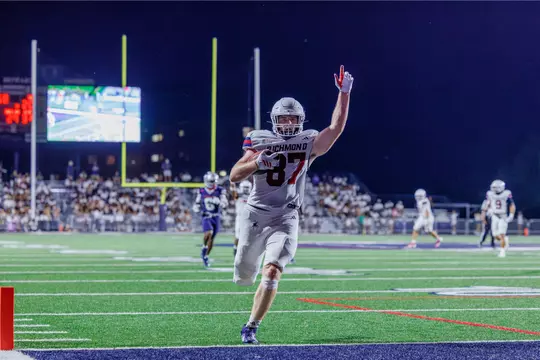
The performance was a fitting milestone, coming nearly 366 days after the injury that had left him wondering when he would be able to walk normally again.
"Just one year from Wofford, what he looks like, it's incredible," Edwards said. "It's a testament to him, his effort, and our training staff."
But the Howard game was only the beginning of what would become Clarke's most productive collegiate season.
Through Richmond's 11 games of 2026, Clarke has recorded 33 receptions for 253 yards and two touchdowns, tied for second on the team in catches.
The production represents an extraordinary jump for a player who entered the season with just 12 career receptions for 85 yards and two touchdowns across his first four seasons.
He has recorded six catches against Fordham and four against Georgetown, and his second touchdown of the season came in Richmond's 40-31 victory at Lafayette on Oct. 3.
For someone whose previous single-season high was six receptions, the numbers illustrate just how far he has come.
Yet Clarke's impact on the Spiders goes beyond the stat sheet.
He has become a dependable target, an experienced presence in the tight ends room and a captain whose teammates have seen firsthand what it takes to overcome adversity.
Clarke said he hasn't spent much time thinking about his injury during the season.
That, in itself, has been part of the accomplishment.
He doesn't want to think about his femur when making a cut or wonder whether another hit might undo his progress. He trusts the rehabilitation process and the work he invested in getting back to the field.
"It's been great being able to get back on the field and do what I always knew I could," Clarke said.
After years of working to earn a place in Richmond's offense, followed by nearly a year of fighting to regain it, Clarke has finally had the opportunity to show what he can do.
THE VALUE OF SHOWING UP
As Clarke approaches the final game of his college career, the numbers tell only part of his story.
He arrived at Richmond as a preferred walk-on, earned a scholarship, developed into a starter and overcame an injury that forced him to rebuild much of the strength and mobility he had spent years developing.
Along the way, he earned something that cannot be measured in receptions or receiving yards.
The respect of his teammates.
For Edwards, Clarke's journey has reinforced what he recognized when he first saw No. 87 on the practice field.
"He's just a great person, a great player to be around," Edwards said. "One of my favorites, for sure."
The path hasn't been easy, and it certainly hasn't unfolded the way Clarke envisioned when he first arrived on campus.
But through the challenges, his approach has remained remarkably consistent.
Show up.
Show up to practice. Show up to lift. Keep working, even when progress feels slow and the circumstances aren't what you envisioned.
"No matter what, just always be at practice, always be at lift, even when you don't want to be," Clarke said. "As long as you show up, then good things will happen."
For nearly a year, Clarke's version of showing up looked different than it once had.
Sometimes it meant crutches, walking the track or standing on the sideline while his teammates practiced.
Now it means running onto the field, catching passes, helping younger teammates and leading the Spiders.
Soon, Clarke will put on a Richmond uniform for the final time.
The catches, yards and touchdowns will become part of his career statistics. The scholarship he earned and the captaincy his teammates bestowed on him will remain milestones in a journey that began with an opportunity few could have predicted would lead this far.
But perhaps the most meaningful part of Clarke's legacy will be the example he leaves behind.
A player who never stopped working to earn his place, even after an injury took away his ability to play the game he loved.
A teammate who found a way to lead when he couldn't take the field.
And a reminder that growth isn't always a straight line, and adversity doesn't have to define the outcome.