University of Richmond Athletics
Web Threads: How Philanthropy Powers Football Advantages
10/15/2026 | Football, General, Spider Athletic Fund
By Christian Gravius, Associate Director of Athletics Public Relations
Web Threads are in-depth, behind-the-scenes stories from those at the heart of Richmond Athletics: student-athletes, staff members, loyal supporters, and more. Web Threads gives a glimpse into the ambitions, motivations, and sacrifices of the individuals who allow Richmond to excel at the highest levels of intercollegiate athletics and academics as well as the philanthropy that supports them every step of the way. Welcome to our web.
Every college football team practices.
Student-athletes in every program watch film, lift weights, condition, prioritize nutrition and recovery and spends countless hours preparing for their next opponent.
Those things are expected.
What can separate one program from another is what happens beyond the expected — the tools, technology and resources that help student-athletes recover more efficiently, prepare more intelligently and get more out of every rep.
At Richmond, philanthropic support is creating those advantages.
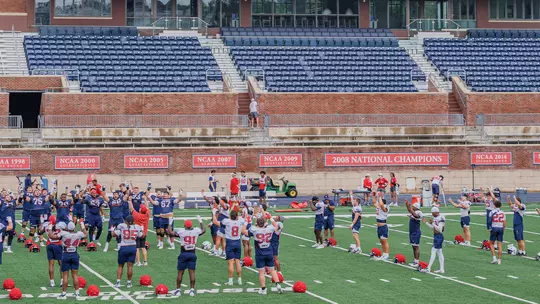
Three recent enhancements to the Spider football student-athlete experience — an on-site cryotherapy chamber at the Robins Center, access to Pro Football Focus player tracking data and helmet-mounted cameras for Richmond’s quarterbacks — show what donor investment can do for a program constantly searching for every possible advantage.
Each investment addresses a different aspect of performance. Together, they represent something larger: the ability to provide Richmond student-athletes with resources that extend beyond the fundamentals and help the Spiders compete in an environment where every program is looking for an edge.
“Some of the things that we’ve gotten based on donor gifts — the technology — it’s amazing. Unbelievable. I think it’s really nice for the guys to have these things, no question,” head coach Russ Huesman said.
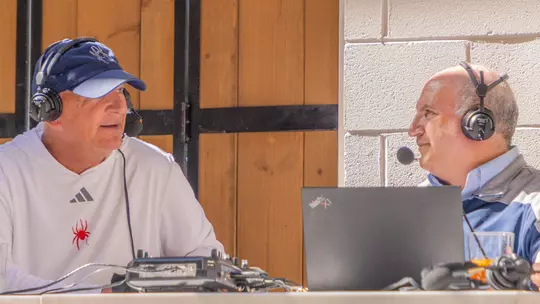
For Richmond football players, one of those advantages is now only steps away.
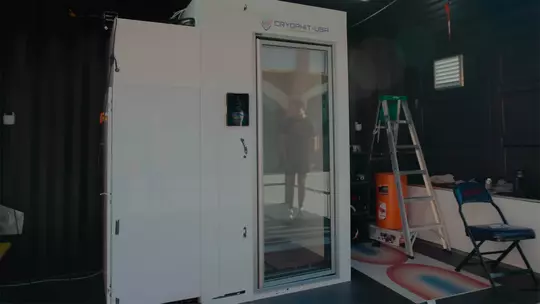
The program has added a mobile cryotherapy chamber at the Robins Center, giving student-athletes another recovery option without requiring them to leave the facility or campus.
Football places intense physical demands on the body throughout a season. Between practices, strength training and games, finding ways to recover and prepare for what’s next is an important part of a student-athlete’s weekly routine.
Cryotherapy exposes the body to extremely cold temperatures for a short time and is used by athletes as one component of a broader recovery program. By placing the chamber on-site, Richmond has made that resource easier to incorporate into the normal rhythm of a player’s day.
The convenience matters.
Richmond football players are not only athletes – they are scholars balancing academic work, football responsibilities and the demands of daily life. Resources that make recovery more accessible help student-athletes use their time more efficiently while giving the sports medicine staff another option in its approach to player care.
“It gives them another tool for recovery. The things that work across the board are sleep, nutrition and hydration, but then you ask, ‘What extra things can we do?’ The cryotherapy chamber gives us another option we can provide our guys,” head football athletic trainer Joe Olivadoti said.
“Tristan Wheeler was going off campus when he was in school here two times a week, using his own money, and said, ‘cryo is the way to go,’” Huesman added. “And you know, Tristan didn’t have too bad of a career here.”
Wheeler had plenty of evidence to support his recommendation. Believed to be the first player in NCAA history to earn All-America honors in five consecutive seasons, he finished his Richmond career with 487 tackles, second most in program history. A five-time All-CAA selection and four-time first-team honoree, Wheeler also started 50 consecutive games to end his career.
Some competitive advantages are readily apparent. Others only appear in the data on a computer screen in a meeting room.
The Spiders are now a subscriber to Pro Football Focus, commonly known as PFF, providing the coaching staff with another layer of data and analysis to complement traditional film study.
Film remains at the center of football preparation. Coaches study opponents, evaluate their own players, and search for tendencies that can help shape a game plan.
Its detailed player grading systems can help coaches sort through personnel, formations, situations, and individual performances while identifying areas that deserve a closer look on film. That can make an already detailed preparation process even more targeted.
The value is not simply having more information. It’s having another way to organize and interpret it.
“When we first got PFF and I tried it, I said, ‘Are you kidding me? Why haven’t we had this for the last three years,” said Huesman.
Donor support allows Richmond to invest beyond the traditional resources required to run a football program, providing access to tools like PFF that can create a competitive edge. By giving coaches another layer of data to evaluate players, identify tendencies and prepare for opponents, that investment helps the Spider search for advantages in the details that can make a difference on Saturdays.
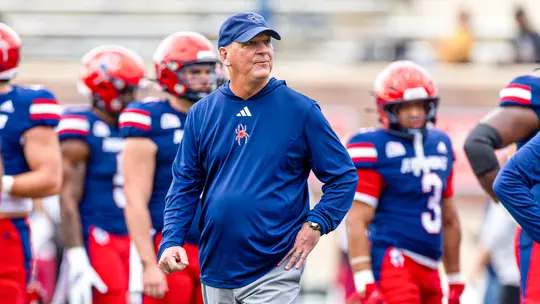
Richmond’s quarterbacks are also seeing practice differently.
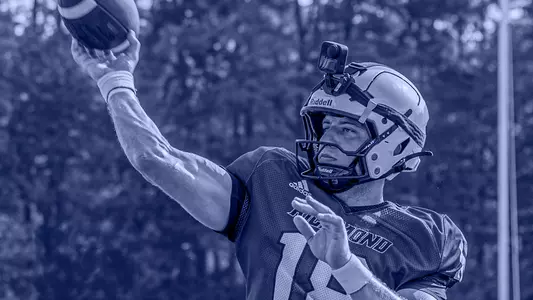
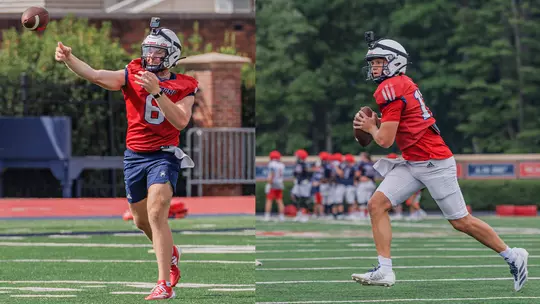
Through donor support, Richmond has introduced helmet-mounted cameras that record practice from the quarterback’s perspective, giving coaches and players a first-person view of each rep.
Traditional practice film remains invaluable, but it can’t always show exactly what a quarterback was seeing at the moment he made a decision.
The helmet camera can.
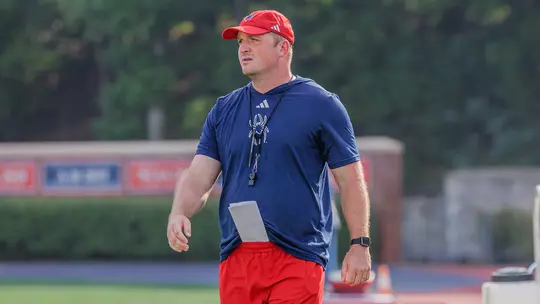
For Co-Offensive Coordinator and Quarterbacks Coach Jacob Huesman, that creates another layer of teaching.
The footage can help show where a quarterback’s eyes went, how coverage appeared from his perspective and what information was available to him as a play unfolded.
“It's helpful for the guys to be able to come back and relive the rep or, if you didn't get that rep in practice, to actually experience the rep,” Huesman said. “Whether it's seeing a coverage in a pass concept or being able to see the front for a particular run check, it lets them experience the rep they may not have gotten in practice.”
For the quarterbacks, the benefit is just as direct.
After practice, they no longer have to rely entirely on memory when explaining what they saw on a particular play. They can return to the meeting room and watch it again from nearly the same perspective through a virtual reality headset.
That can make conversations about reads, timing, eye discipline and decision-making more specific.
In a position where development is built on repetition, the camera can also help Richmond get more value from every drop back.
A quarterback might see a particular defensive look only a handful of times during a practice. The technology allows that experience to continue after the whistle, turning one rep on the field into another teaching opportunity in the meeting room.
“The helmet cameras have given us an extra layer of training that combines film study and practice,” Spiders’ starting quarterback and fifth-year senior Ashten Snelsire said. “Visualization is an important mental performance practice, and being able to use the VR headset to not only visualize but relive every play from practice is huge for improvement. It allows younger quarterbacks to get reps on the VR when they may not have gotten a lot of reps in practice, so they can learn the offense much quicker and be more prepared for when their reps do come.”
The fundamentals of college football are not going anywhere.
Richmond will practice, lift, condition, study film and prepare the same way other successful programs have for generations.
But building a program capable of competing at the highest level requires finding opportunities beyond the expected.
Today, a Spider can walk off the practice field and into a cryotherapy chamber. A coach can use advanced data to uncover something traditional film study may have missed. A quarterback can finish a rep, then see it again through his own eyes.
College football is filled with programs searching for ways to stand out.
The fundamentals build a football program. Philanthropy gives Richmond the opportunity to accelerate beyond.
These enhancements are just a few examples of how donor support is making a difference in the lives of Richmond student-athletes. We are grateful to the loyal supporters of Spider Nation whose generosity makes these resources possible and creates opportunities for our 400 student-athletes to excel on and off the field.